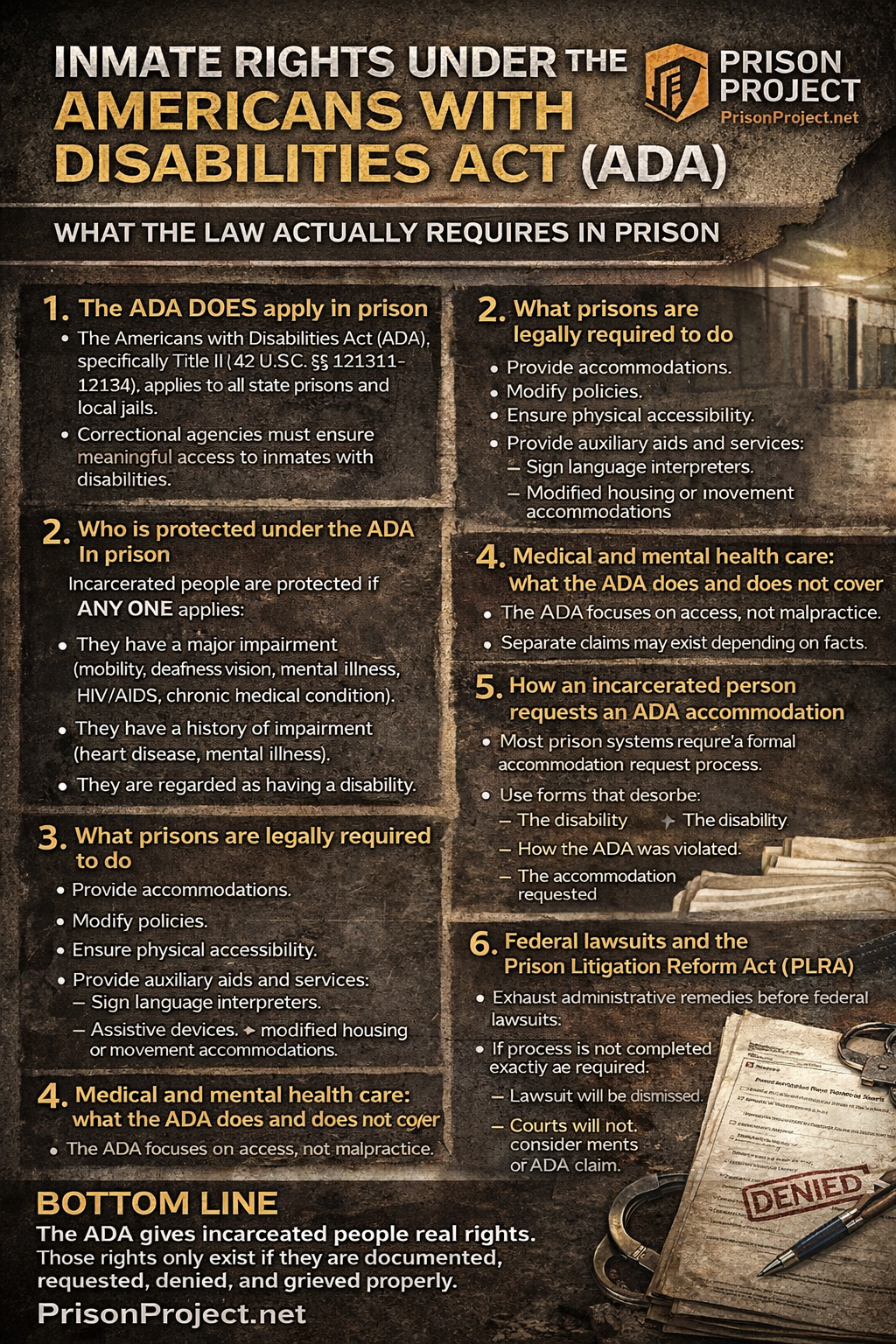
INMATE RIGHTS UNDER THE AMERICANS WITH DISABILITIES ACT (ADA)
WHAT THE LAW ACTUALLY REQUIRES IN PRISON
1. The ADA DOES apply in prison
The Americans with Disabilities Act (ADA), specifically Title II (42 U.S.C. §§ 12131–12134), applies to all state prisons and local jails. Incarceration does not strip a person of ADA protections. Prisons are public entities under the law and must comply.
This means correctional agencies are legally required to ensure that incarcerated people with disabilities have meaningful access to prison programs, services, and activities.
2. Who is protected under the ADA in prison
An incarcerated person is protected by the ADA if ANY ONE of the following applies:
• They have a physical or mental impairment that substantially limits one or more major life activities.
Examples include mobility impairments, deafness or hearing loss, vision impairments, intellectual disabilities, serious mental illness, HIV/AIDS, or chronic medical conditions.
• They have a documented history or record of such an impairment.
Example: a prior diagnosis of heart disease or mental illness.
• They are regarded as having a disability by prison officials.
Example: being denied a job or program based on assumptions about seizures or mental health.
Most incarcerated people with disabilities are considered “qualified” under the ADA because they can meet program requirements with reasonable accommodations.
3. What prisons are legally required to do
Under the ADA, prisons must:
• Provide reasonable accommodations so people with disabilities can participate in programs and services
• Modify policies, rules, or practices when necessary
• Ensure physical accessibility where required
• Provide auxiliary aids and services, such as:
– Sign language interpreters
– Assistive devices
– Modified housing or movement accommodations
Prisons cannot exclude someone from programs solely because of a disability.
4. Medical and mental health care: what the ADA does and does not cover
Failure to provide adequate medical or mental health care may violate the ADA, but not automatically.
• The ADA focuses on access and discrimination, not medical malpractice
• If a prison denies care because of disability or fails to accommodate a disability-related need, ADA claims may apply
• Separate constitutional or civil rights claims may also exist depending on the facts
This distinction matters when framing grievances and lawsuits.
5. How an incarcerated person requests an ADA accommodation
Most prison systems require a formal accommodation request process.
Using Pennsylvania as an example (similar structures exist nationwide):
1. The incarcerated person completes an Accommodation Request Form
2. The form must describe:
– The disability
– Why accommodation is needed
– The specific accommodation requested
3. The request is submitted to prison medical or healthcare administration
4. Prison officials evaluate medical records and may interview staff or the inmate
5. A written recommendation is made
6. A centralized committee or authority issues a final decision, often within a defined timeframe (for example, 20 days)
Key point:
If the incarcerated person does not follow the accommodation request process, it can later block legal relief.
6. ADA-related grievances: the step people skip and lose on
If an accommodation is denied, delayed, or ignored, the incarcerated person must file a formal grievance.
A valid ADA grievance should clearly state:
• The disability
• How the ADA was violated
• The accommodation requested and denied
This step is not optional.
7. Federal lawsuits and the Prison Litigation Reform Act (PLRA)
Under the PLRA (42 U.S.C. § 1997e):
• All incarcerated people must exhaust administrative remedies before filing a federal lawsuit
• This includes filing accommodation requests, filing grievances, and appealing denials through all required levels
If this process is not completed exactly as required:
• The lawsuit will be dismissed
• Courts will not consider the merits of the ADA claim
8. Why documentation is everything
Courts do not investigate stories.
They investigate records.
For ADA claims:
• No accommodation request = no claim
• No grievance = no exhaustion
• No paper trail = no lawsuit
The record proves:
• The disability was known
• The request was made
• The prison responded (or failed to)
• Deadlines were met or ignored
9. What families should understand
Families often focus on outcomes.
Courts focus on process.
If the process is not followed:
• Even valid ADA violations become legally invisible
• Relief becomes impossible not because the harm did not occur, but because it was not preserved
BOTTOM LINE
The ADA gives incarcerated people real rights.
Those rights only exist if they are documented, requested, denied, and grieved properly.
No promises.
No shortcuts.
Just the record.
Comments