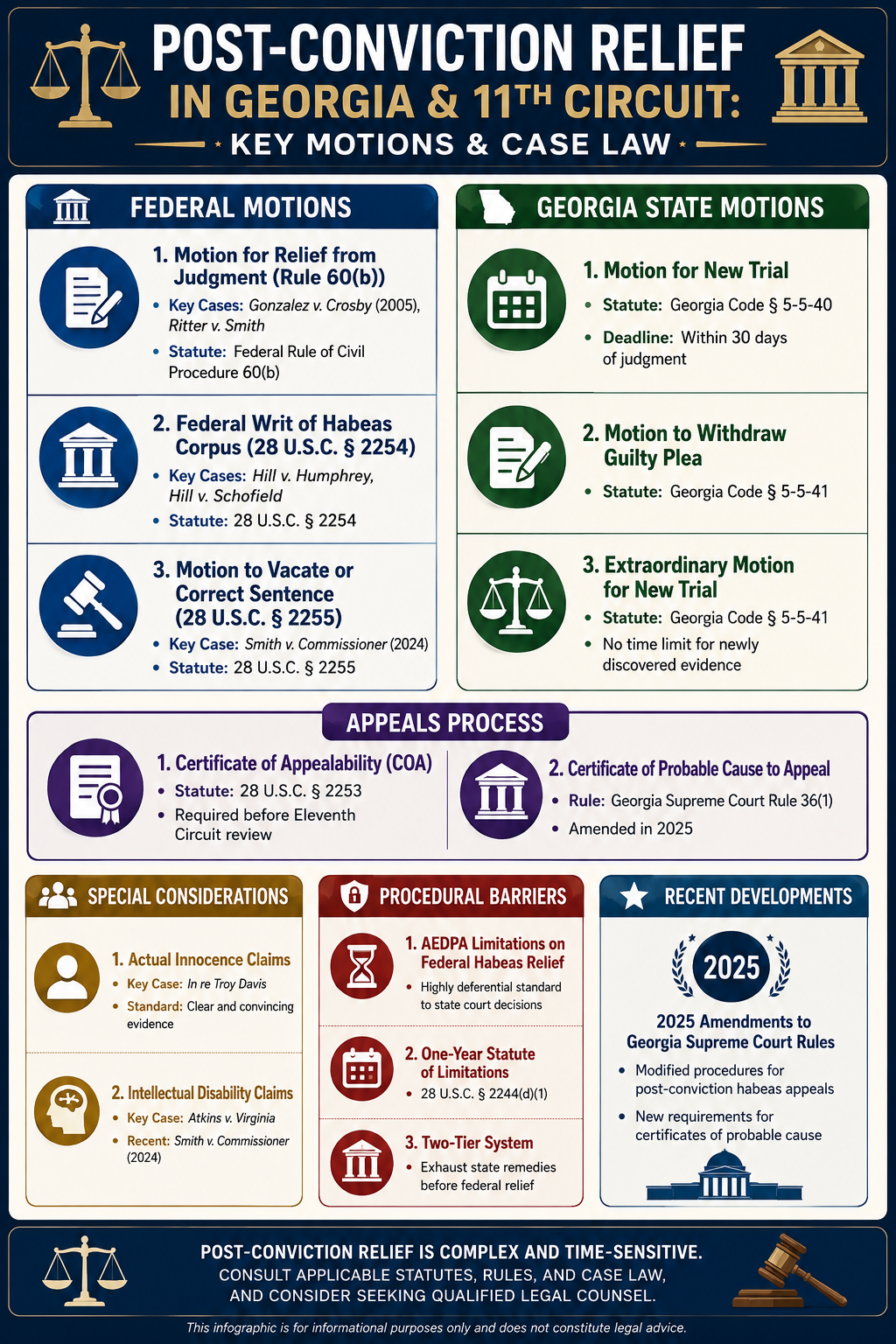
 Key Case Law and Statutes for Post-Conviction Relief Motions in Georgia and the 11th Circuit
Federal Habeas Corpus Motions
Motion for Relief from Judgment (Rule 60(b))
Gonzalez v. Crosby (2005) - Establishes that a Rule 60(b) motion that seeks to reopen a federal court's final decision rejecting a habeas petitioner's challenge to a state criminal conviction does not constitute a second or successive habeas corpus application under AEDPA.
Ritter v. Smith (811 F.2d 1398, 11th Cir.) - Held that "a change in law standing alone was not a proper basis for Rule 60(b) relief absent extraordinary circumstances".
Statute: Federal Rule of Civil Procedure 60(b) - Allows relief from judgment for various reasons including newly discovered evidence, fraud, or any other reason justifying relief.
Federal Writ of Habeas Corpus (28 U.S.C. § 2254)
Hill v. Humphrey (662 F.3d 1335, 11th Cir.) - Addressed intellectual disability claims in death penalty cases.
Hill v. Schofield (625 F.3d 1313, 11th Cir.) - Further developed standards for capital case habeas petitions.
Statute: 28 U.S.C. § 2254 - Provides the procedure for state prisoners to seek federal habeas corpus relief after exhausting state remedies.
Motion to Vacate or Correct Sentence (28 U.S.C. § 2255)
Smith v. Commissioner (2024 WL 4793028, 11th Cir.) - Recent case where the Eleventh Circuit found relief on an Atkins claim for intellectual disability.
Statute: 28 U.S.C. § 2255 - Allows federal prisoners to challenge their conviction or sentence on constitutional grounds.
Georgia State Court Motions
Motion for New Trial
Georgia Code § 5-5-40 - Requires filing within 30 days of judgment for a motion for new trial.
Recent cases: Law firms have successfully won motions for new trial in child pornography and other criminal cases.
Motion to Withdraw Guilty Plea
Georgia Code § 5-5-41 - Provides the statutory framework for withdrawing guilty pleas within certain time limits.
Case law: Requires showing of manifest injustice or constitutional violation.
Extraordinary Motion for New Trial
Georgia Code § 5-5-41 - Allows for extraordinary motions for new trial with no time limit when based on newly discovered evidence.
State Habeas Corpus Petition
Georgia Code § 9-14-40 et seq. - Governs state habeas corpus petitions.
In re Troy Davis - Significant case where the Supreme Court transferred to the Southern District of Georgia to examine actual innocence claims.
Georgia Supreme Court Rule 36(2) - Sets out procedures and preliminary requirements for filing original habeas petitions (amended in 2025).
Appeals Process
Certificate of Appealability (COA)
28 U.S.C. § 2253 - Requires obtaining a COA from a circuit justice before appealing a habeas corpus decision.
Eleventh Circuit Procedure: Must obtain COA before the Eleventh Circuit will review habeas decisions.
Certificate of Probable Cause to Appeal
Georgia Supreme Court Rule 36(1) - Amended in 2025 to establish procedures for certificates of probable cause to appeal in habeas cases.
Special Considerations
Actual Innocence Claims
In re Troy Davis - Established that "the Eighth Amendment precludes execution of the actually innocent" with the clear and convincing evidence standard.
Standard: Clear and convincing evidence of actual innocence required to overcome procedural barriers.
Intellectual Disability Claims
Atkins v. Virginia - Supreme Court precedent prohibiting execution of intellectually disabled persons.
Smith v. Commissioner (2024) - Recent Eleventh Circuit application of Atkins standard.
Procedural Barriers
Antiterrorism and Effective Death Penalty Act (AEDPA) - Imposes stringent limitations on federal habeas corpus relief.
One-Year Statute of Limitations: 28 U.S.C. § 2244(d)(1) imposes a one-year limitation period for federal habeas petitions.
The Eleventh Circuit, based in Atlanta, Georgia, has appellate jurisdiction over federal courts in Georgia, Alabama, and Florida. Recent amendments to Georgia Supreme Court rules in 2025 have modified procedures for post-conviction habeas corpus appeals, particularly regarding original petitions and certificates of probable cause.
Comments